
Tracepoint Intelligence Resources
Tools and resources to help leaders strengthen digital due diligence, integrity, and decision-making.
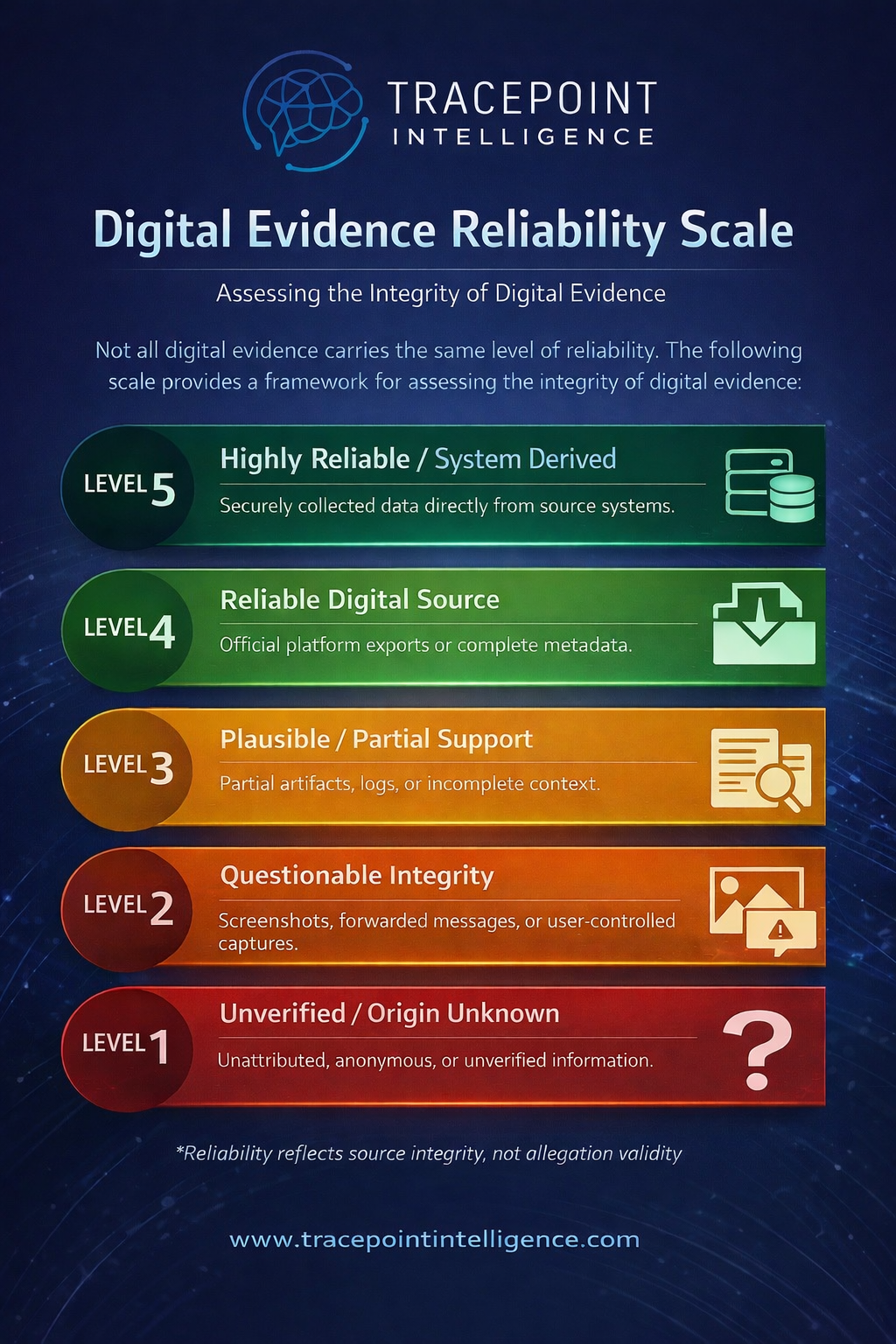
Featured Resource - Tracepoint Intelligence Digital Evidence Reliability Scale
Digital Evidence Reliability Scale
Assessing the integrity of digital evidence—before conclusions are drawn.
Digital evidence is often treated as inherently reliable. In practice, its evidentiary value varies significantly depending on how it was generated, captured, and preserved.
This scale provides a structured framework to assess the integrity and evidentiary weight of digital materials—supporting more disciplined, defensible decision-making.
How to use it:
Triage and assess incoming evidence in complaints, investigations, and internal reviews
Differentiate between user-controlled artifacts and system-derived records
Identify evidentiary gaps and prioritize higher-integrity sources
Strengthen the defensibility of findings across legal, HR, and corporate contexts
Key principle:
Reliability reflects source integrity—not allegation validity. Evidentiary strength must be evaluated independently of the narrative it appears to support.
Related Insights Article: Employee Activity Monitoring Risks: Digital Evidence Challenges in Workplace Investigations
Download & Use
Intended for practical application in active matters. This resource can be incorporated into intake, triage, and investigative workflows to support consistent, evidence-based assessments.
Need support applying this framework to a live matter? Tracepoint provides Digital Evidence Review for Workplace Investigations.
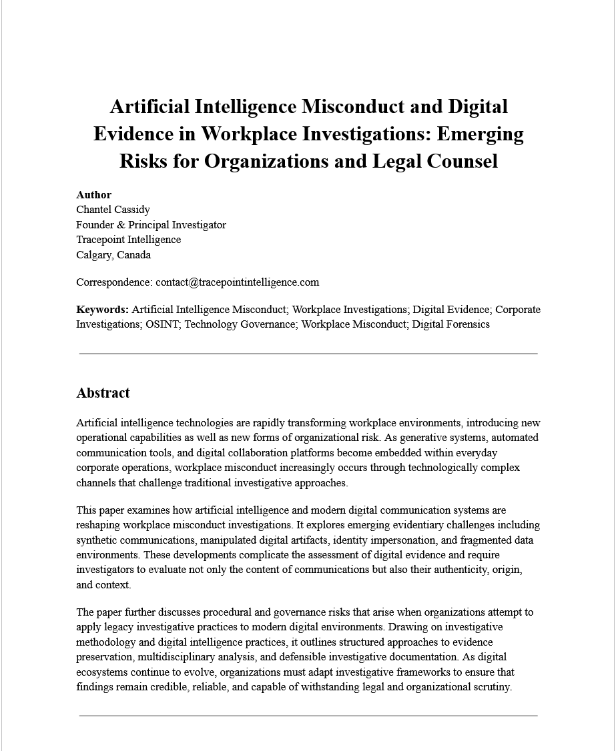
Research Paper: AI Misconduct and Digital Evidence in Workplace Investigations
Emerging Risks for Organizations and Legal Counsel
This research paper examines how artificial intelligence is reshaping workplace misconduct investigations and the evaluation of digital evidence.
As organizations increasingly rely on digital communication platforms and AI-enabled tools, investigators are encountering new evidentiary challenges involving synthetic communications, manipulated digital artifacts, and fragmented data environments.
The paper explores emerging investigative risks and outlines structured investigative approaches organizations can use to preserve evidence, analyze digital records, and reach defensible conclusions in complex workplace matters.
Cassidy, C. (2026). Artificial Intelligence Misconduct and Digital Evidence in Workplace Investigations: Emerging Risks for Organizations and Legal Counsel. ResearchGate.
DOI: 10.13140/RG.2.2.14507.09767
This paper was developed as part of Tracepoint Intelligence’s ongoing research into AI-enabled workplace misconduct and digital investigative methodologies.
AI-Era Misconduct Investigation Framework™
A practical handbook for HR, legal, and corporate leaders navigating workplace misconduct in an AI-mediated world.

The nature of workplace misconduct has changed.
Most investigation frameworks have not.
AI-assisted content, blurred authorship, digital traces, and evolving standards of evidence are now routine features of modern workplace investigations. Yet many organizations are still relying on investigative approaches designed for a pre-AI era.
The AI-Era Misconduct Investigation Framework was developed to close that gap.
This handbook provides a clear, defensible structure for understanding, assessing, and navigating misconduct allegations in environments shaped by artificial intelligence, digital systems, and emerging risk patterns.
What this framework provides
This framework offers:
A structured approach to assessing AI-related and digitally mediated misconduct
Clear investigative principles grounded in modern evidence realities
Decision guidance for HR and legal leaders operating under uncertainty
Practical insight into credibility, authorship, intent, and verification challenges
Governance-aware guidance aligned with real-world investigative constraints
The emphasis throughout is on sound judgement, defensibility, and professional rigor — not novelty.
How this framework is used
This handbook is designed to support:
HR leaders responsible for investigation oversight
Employment and workplace lawyers advising organizations or conducting investigations
Corporate decision-makers managing risk, escalation, and governance
Investigators seeking a modern analytical lens
It is equally relevant for internal practitioners and external advisors.
What is included
The framework includes:
A comprehensive investigation model tailored to AI-era misconduct
Applied guidance across common modern investigation scenarios
Workbooks and templates designed to support structured thinking and analysis
Case-based illustrations and decision considerations
Clear boundaries between conceptual guidance and internal operational practice
What this handbook is not
This framework is not:
An internal investigation SOP
A governed operational toolkit
A set of organization-wide investigation systems
A substitute for legal advice
It is intentionally designed as a professional handbook — not an internal operating standard.
Who is this for
This framework is built for:
HR leaders
Employment and workplace lawyers
Corporate executives and decision-makers
Investigators and governance professionals
If you are responsible for investigations — or accountable for their outcomes — this framework was written for you.
For broader context on AI-era misconduct, see our strategic guide in our article:
AI-Era Workplace Misconduct: What Employers, HR, and Legal Leaders Need to Know
Executive Preview (Issuu Publication):
[Issuu Link]
Featured Tracepoint Insights
A selection of recent articles exploring how digital due diligence, ethical investigations, and open-source intelligence help organizations build cultures of truth and accountability.