The Anatomy of Internal Workplace Misconduct in a Digital World: Early Signals Leaders Miss
Classification: Organizational Intelligence
Category: Misconduct Patterning & Behavioural Risk
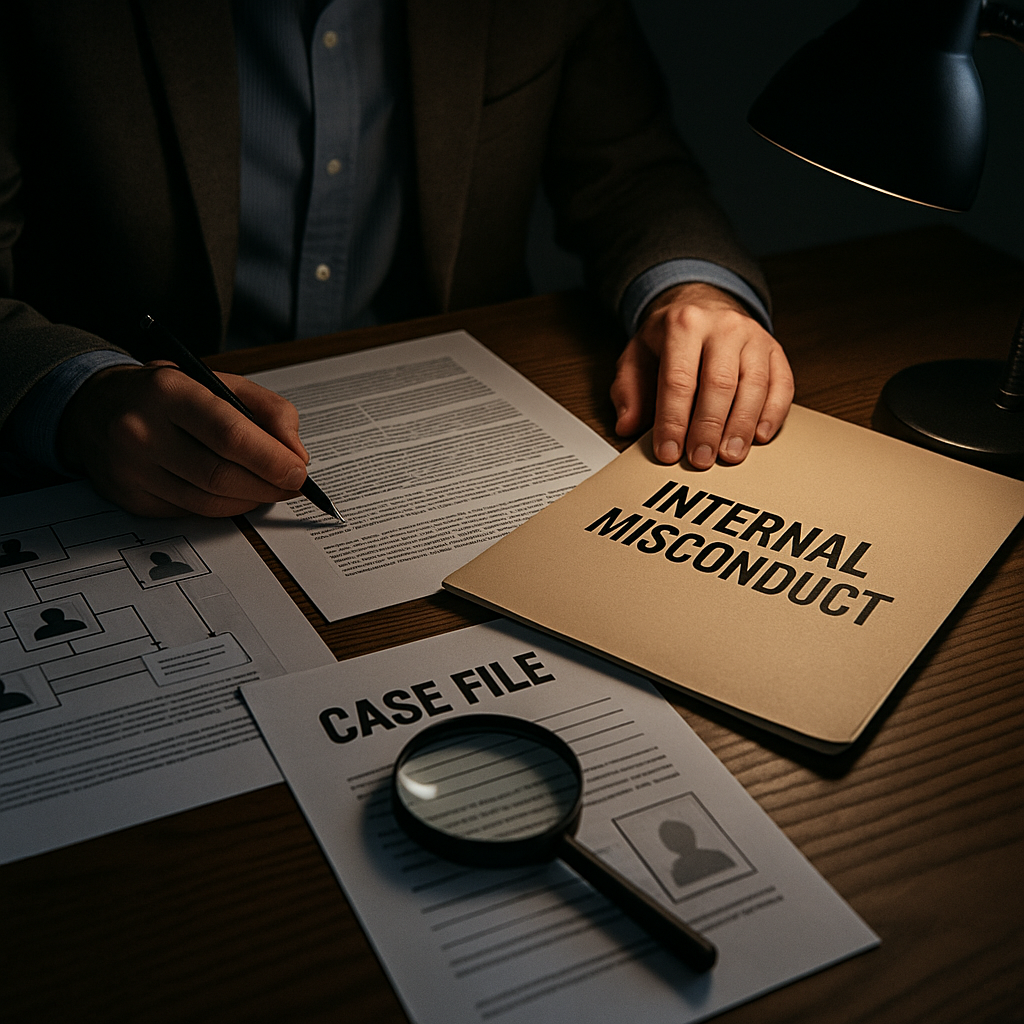
Early-stage misconduct rarely looks dramatic. It looks like documents shifting hands, decisions made off-path, and patterns forming long before anyone notices. This is where internal intelligence begins — and where Tracepoint steps in.
Misconduct Rarely Starts With a Scandal
Most leaders imagine misconduct as something loud, dramatic, and obvious — a blatant breach, an explosive HR incident, a smoking gun.
But the truth is quieter.
More strategic.
More insidious.
Internal misconduct rarely appears fully formed.
It begins as microscopic behavioural shifts — subtle, deniable, almost invisible — until the pattern finally breaks containment.
By the time an organization “discovers” it, the misconduct has usually been unfolding for months or even years.
Tracepoint’s work often begins at that stage — when the damage is visible but the origin isn’t.
But the real intelligence advantage lies in identifying the patterns before they escalate.
The Hidden Lifecycle of Internal Misconduct
Through hundreds of investigative analyses and internal intelligence audits, Tracepoint has identified a consistent trajectory in how misconduct emerges inside organizations:
Behavioural drift
Boundary testing
Pattern formation
Normalization
Containment failure
The early stages — especially 1 through 3 — are almost always missed by leaders who assume risk looks like defiance.
It doesn’t.
It looks like small decisions that don’t feel important at first.
The wrong person being consulted
A pattern of emails that avoid accountability
Micro-alliances forming in the shadows of the org chart
A leader who changes tone depending on who’s watching
At Tracepoint, these early shifts are treated as organizational OSINT indicators.
Not loud.
Not dramatic.
But unmistakable, once you know what to look for.
The Early Signals Most Leaders Overlook
Let’s break down the most critical early-stage indicators of internal misconduct — the ones that consistently precede more serious breaches.
These are the red flags that show up long before HR, legal, or senior leadership realizes the system is compromised.
1. Stakeholder Removal or Exclusion
When key decision-makers are quietly excluded from discussions they should be leading, it is almost always a sign of:
political behaviour
misinformation
power consolidation
future narrative control
distrust in the leadership chain
This exclusion rarely appears as an overt act.
It’s concealed in:
who is asked
who is informed
who is consulted
who is intentionally ignored
In investigative work, the absence of a person is often more revealing than their presence.
2. Informal Decision Pathways Begin to Form
When decisions stop flowing through legitimate channels and instead move through:
personal alliances
back-channel conversations
politically aligned voices
employees with no formal accountability
…the risk profile escalates dramatically.
We call this informal network creep.
It is the earliest stage of organizational rot.
3. Role Confusion That’s Not Actually Confusion
Misconduct often hides inside “role ambiguity,” which is almost never accidental.
It is often a covert strategy to:
diffuse accountability
obscure responsibility
weaken control structures
create plausible deniability
shift blame to uninvolved parties
This tactic appears sophisticated, but it’s rarely driven by intelligence — usually insecurity and self-preservation.
4. Emotional Inconsistencies in Leadership Behaviour
Leaders involved in, adjacent to, or enabling misconduct often display:
selective engagement
abrupt tone shifts
unexplained absences
silence in moments where communication is required
hyper-responsiveness toward certain individuals
avoidance of others
These patterns indicate internal stress and shifting alliances.
People behave differently when they’re managing a hidden agenda — even when they think they’re concealing it.
5. Decision-Making That Prioritizes Loyalty Over Competence
This is one of the most predictive indicators.
When leaders begin choosing:
junior staff
underperforming individuals
politically aligned employees
instead of experienced, competent, accountable leaders…
…it reveals a shift toward a protection-based leadership model — the most common precursor to misconduct escalation.
Weak leaders look for people who won’t challenge them.
Misconduct thrives in that vacuum.
Case File: The Displaced Director
Below is a fully fictionalized Tracepoint case file, designed to reflect a pattern we see frequently — while protecting anonymity and organizational identity.
🗂️ TRACEPOINT CASE FILE — CF-1147
The Displaced Director
Status: Fully Resolved
Risk Level: Escalating → Confirmed Pattern
Environment: Mid-Market, Operations
Summary:
A Director responsible for a large operational team noticed she was increasingly excluded from decisions involving the very function she oversaw. Each exclusion was minor on its own, but cumulatively revealed a deeper pattern:
junior individuals being consulted over her
past underperformers suddenly given influence
missing information loops
altered communication pathways
senior leadership shifting toward unofficial alliances
No single event constituted a breach.
But the pattern did.
Tracepoint categorized the risk as leadership-driven political exclusion, one of the most common precursors to internal misconduct escalation.
Key Indicators Identified:
Competency bypass: Underqualified employees were treated as advisors
Shadow network formation: Decisions flowed through personal familiarity, not structure
Information gatekeeping: The Director frequently learned about decisions secondhand
Power realignment: Senior leadership consolidated influence by excluding high-competence individuals
Outcome:
Tracepoint’s pattern mapping revealed:
A trust collapse within the leadership chain
A high-risk senior leader acting to protect his political position
Manipulation of staffing decisions to shift future accountability
Gendered exclusion indicators consistent with systemic bias
The organization corrected the structure once the pattern was surfaced — but the early signs had been visible for months.
Most organizations simply don’t know how to interpret them.
Why Leaders Miss These Signals
1. Misconduct doesn’t look like misconduct at first
It looks like inefficiency, oversight, or personality conflict.
2. The earliest signs are interpersonal, not operational
Most leaders favor operational data over behavioural intelligence.
3. Organizations assume silence equals stability
It doesn’t.
Silence is often the first symptom of a system under strain.
4. High performers become invisible when systems decay
As political networks strengthen, competent voices get pushed out of the frame.
5. Misconduct hides inside plausible deniability
Small actions are easy to justify.
Patterns are not — but most leaders don’t step back far enough to see them.
Tracepoint’s Framework for Early Detection
Tracepoint uses a specialized methodology to detect these early cues before they become full-scale incidents:
🔎 Behavioural Sequence Analysis
Patterns of silence, exclusion, or alliance-building.
🔎 Communication Forensics
Email pathways, stakeholder mapping, and decision-flow discrepancies.
🔎 Leadership Pattern Diagnostics
Identifying political behaviour, trust collapse, and hidden influence networks.
🔎 Organizational OSINT
Mapping internal “signals” the way an investigator maps online indicators.
When combined, these tools reveal misconduct before it outwardly emerges — often months before an organization sees the symptoms.
The Signals Are Always There
Misconduct is never sudden.
It is engineered over time, intentionally or unintentionally, through dozens of small choices that slowly reshape the power structure inside an organization.
The earlier you see the pattern, the earlier you contain the risk.
This is where Tracepoint operates:
in the quiet moments, the subtle exclusions, the behavioural shifts that appear insignificant but mean everything.
Because the truth is simple:
Internal misconduct doesn’t start in the shadows.
It starts in plain sight — in the places no one is trained to look.
About Tracepoint Intelligence
Tracepoint Intelligence is a boutique investigations firm specializing in digital investigations, workplace misconduct investigations, open-source intelligence (OSINT), and corporate risk intelligence for organizations, HR leaders, and legal counsel across North America.