Why Email Patterns Predict Internal Risk Better Than Employee Surveys
Classification: Organizational Intelligence
Category: Communication Forensics, Misconduct Detection, Leadership Behaviour Analysis
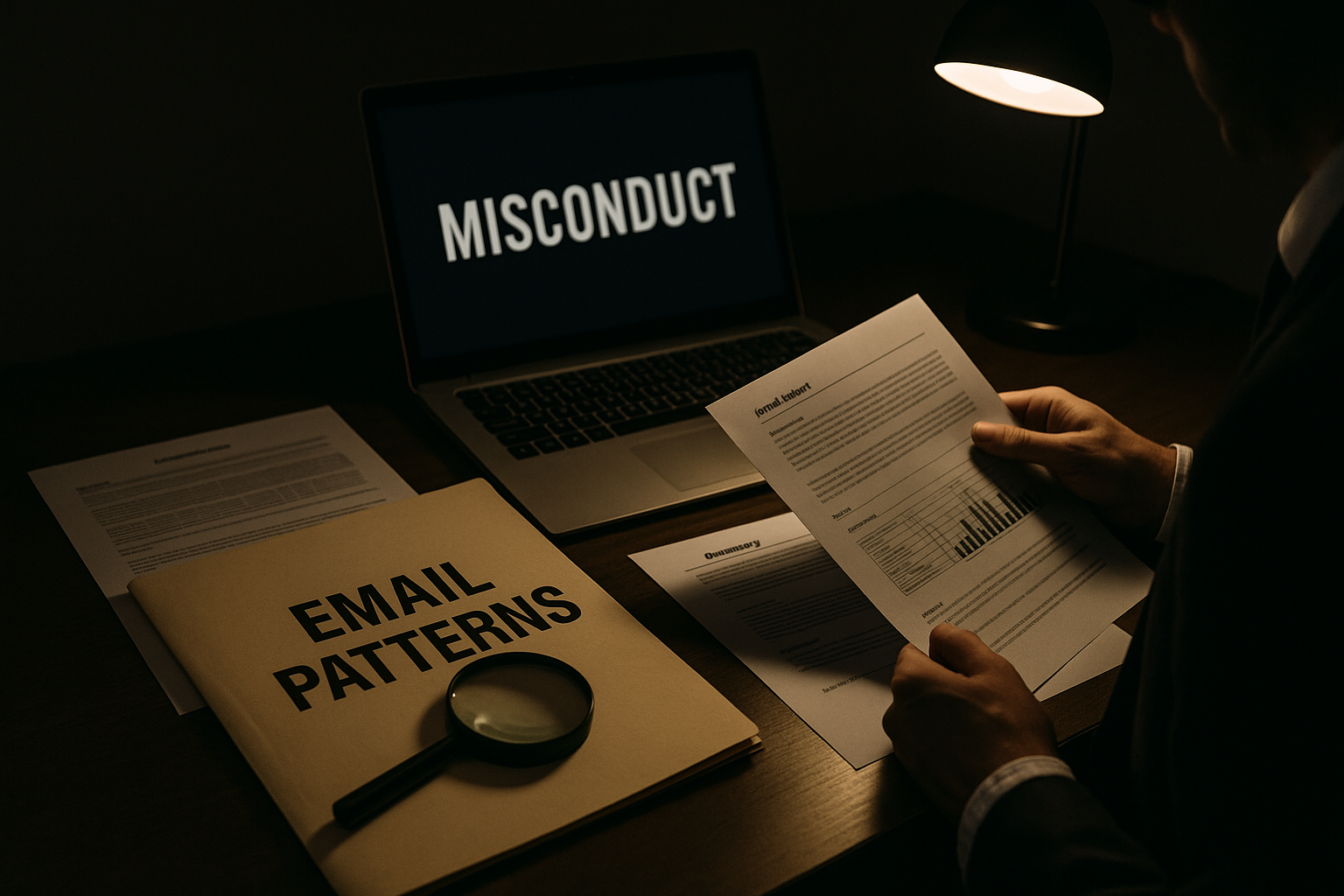
Email patterns don’t lie. Before internal misconduct becomes visible, it shows up in who people copy, who they avoid, and how communication quietly shifts.This image reflects the forensic side of organizational intelligence — where patterns, not words, reveal the truth long before HR ever sees the first symptom.
The Most Honest Part of an Organization Isn’t the Culture — It’s the Email Trail
Employee surveys paint a polished picture.
Interviews present curated perspectives.
Town halls echo what people think leadership wants to hear.
But the email system?
That’s where the truth lives.
Communication forensics — the analysis of email patterns, not content — consistently reveals internal risk months before surveys, feedback loops, or HR systems ever identify a problem.
Most organizations measure sentiment.
Tracepoint measures behaviour.
And behaviour is always more predictive.
Why Email Data Exposes Internal Risk So Effectively
Emails record what people actually do — not what they claim they do.
Over hundreds of investigations, Tracepoint has identified three consistent realities:
1. People change how they communicate before they change how they behave
Every major internal incident — misconduct, toxic leadership, political sabotage, fraud — leaves a communication signature before the event occurs.
The signature shows up in:
timing
tone
recipient selection
copy patterns
message avoidance
escalation paths
People shift their communication long before they shift their actions.
2. Emails reflect unspoken power structures
The org chart says one thing.
The email network reveals the truth.
Patterns show:
who actually holds influence
who is being bypassed
who is forming alliances
who is being isolated
who leadership trusts
who leadership fears
who leadership ignores
Employee surveys never reveal this level of clarity.
3. Email ecosystems are predictable — until misconduct begins
Healthy organizations have stable communication flows.
When internal risk begins to form, email patterns become:
erratic
asymmetrical
avoidant
shadowed
politically selective
unusually top-heavy or bottom-heavy
Dysfunction never appears suddenly.
It appears subtly — and always in communication first.
The Six Email Pattern Indicators of Internal Risk
These indicators reveal misconduct long before anyone reports it.
1. Stakeholder Bypass
When a key leader or subject-matter owner is consistently:
left off email threads
consulted after decisions
copied only on “final” messages
looped in at odd stages
…it is almost always a sign of:
political manoeuvring
leadership insecurity
hidden conflict
agenda-driven decision-making
Bypass is the most reliable early signal.
2. Sudden Copy Escalation
Employees begin copying:
VPs
legal
HR
peers
unrelated leaders
This signals:
fear
conflict escalation
mistrust
alliance-building
narrative shaping
People escalate by copy before they escalate in behaviour.
3. Copy Removal
More dangerous than escalation is removal.
Someone is quietly removed from threads
A stakeholder no longer receives updates
A leader suddenly stops being included in decisions they normally own
This indicates:
internal politics
gatekeeping
emerging misconduct
power consolidation
Copy removal is one of the strongest predictors of leadership collapse.
4. Tone Shifts
You can map tone changes before incidents occur.
Common signals:
abrupt formality
defensiveness
unusually polished language
vague phrasing
reduction in detail
passive constructions (“It was decided…”)
increased filler and softeners
Tone becomes more curated as risk escalates.
5. Timing Patterns
Risk correlates with abnormal timing.
Examples:
emails sent unusually late
sudden morning silences
long delays followed by bursts
predictable avoidance patterns
repeated “after hours” decision-making
These timing anomalies map stress, conflict, and secrecy.
6. Cross-Functional Drift
When communication suddenly shifts sideways instead of upward or downward, it indicates:
faction-building
executive favour-seeking
attempts to influence narratives
conflict avoidance
informal alliances
Healthy organizations communicate vertically.
Unstable ones communicate diagonally.
Why Employee Surveys Miss All of This
Surveys capture perception.
Emails capture behaviour.
Surveys reflect:
what employees feel safe saying
how they want leadership to perceive them
yesterday’s problems
socially acceptable responses
Emails reflect:
unfiltered power dynamics
real-time stress
evolving alliances
silent exclusion patterns
political strategy
cracks in the leadership chain
Surveys are theatre.
Emails are evidence.
Case File: The Vanishing Director
A fictionalized but realistic Tracepoint case, based on recurring patterns seen across multiple organizations.
🗂️ TRACEPOINT CASE FILE — CF-3119
The Vanishing Director
Status: Confirmed Pattern → Leadership Collapse
Sector: Corporate Operations
Summary
A Director overseeing a major function began noticing subtle shifts:
fewer emails from peers
unusual delays
decisions occurring without him
sudden “looping in” after the fact
Individually, none of it looked alarming.
But the email network told a different story.
Communication Forensics Findings:
Tracepoint identified:
a consistent bypass pattern originating from one senior leader
threads where he was intentionally removed
escalating copy behaviour among junior employees
cross-functional communication that avoided him entirely
a new informal influence cluster forming
decision-making shifting into a shadow group
The Director was not the problem.
He was the target of a political realignment.
Outcome:
Within four months, the function destabilized.
Within six months, three key employees resigned.
Within nine months, the senior leader responsible was removed.
The earliest signs?
Email patterns — eight months before leadership understood the risk.
How Tracepoint Uses Email Forensics to Detect Misconduct Early
Tracepoint does not read employee emails.
We analyze:
metadata
flow patterns
communication graphs
timing
structure
exclusions
escalation behaviour
stakeholder involvement
This allows us to:
🔎 Identify hidden influence networks
🔎 Detect emerging misconduct clusters
🔎 Map political behaviour
🔎 Reveal leadership breakdowns before HR sees symptoms
🔎 Pinpoint gatekeeping and exclusion
🔎 Classify risk by behaviour, not opinion
Employee surveys give organizations a rearview mirror.
Email patterning gives them radar.
The Inbox Always Knows First
Before a workplace incident occurs,
before a resignation,
before a conflict ignites,
before misconduct becomes visible…
…the email system already knows.
Communication forensics exposes what the culture hides.
It is not surveillance — it is intelligence.
And in a world where risk evolves quietly,
email patterns remain the most accurate early-warning system organizations have.
Because internal misconduct begins in conversation —
long before it becomes an incident.
About Tracepoint Intelligence
Tracepoint Intelligence is a boutique investigations firm specializing in digital investigations, workplace misconduct investigations, open-source intelligence (OSINT), and corporate risk intelligence for organizations, HR leaders, and legal counsel across North America.