OSINT for HR: How Digital Footprints Reveal Workplace Misconduct
Classification: Organizational Intelligence
Category: Digital Investigations, HR Risk, Behavioural Analysis
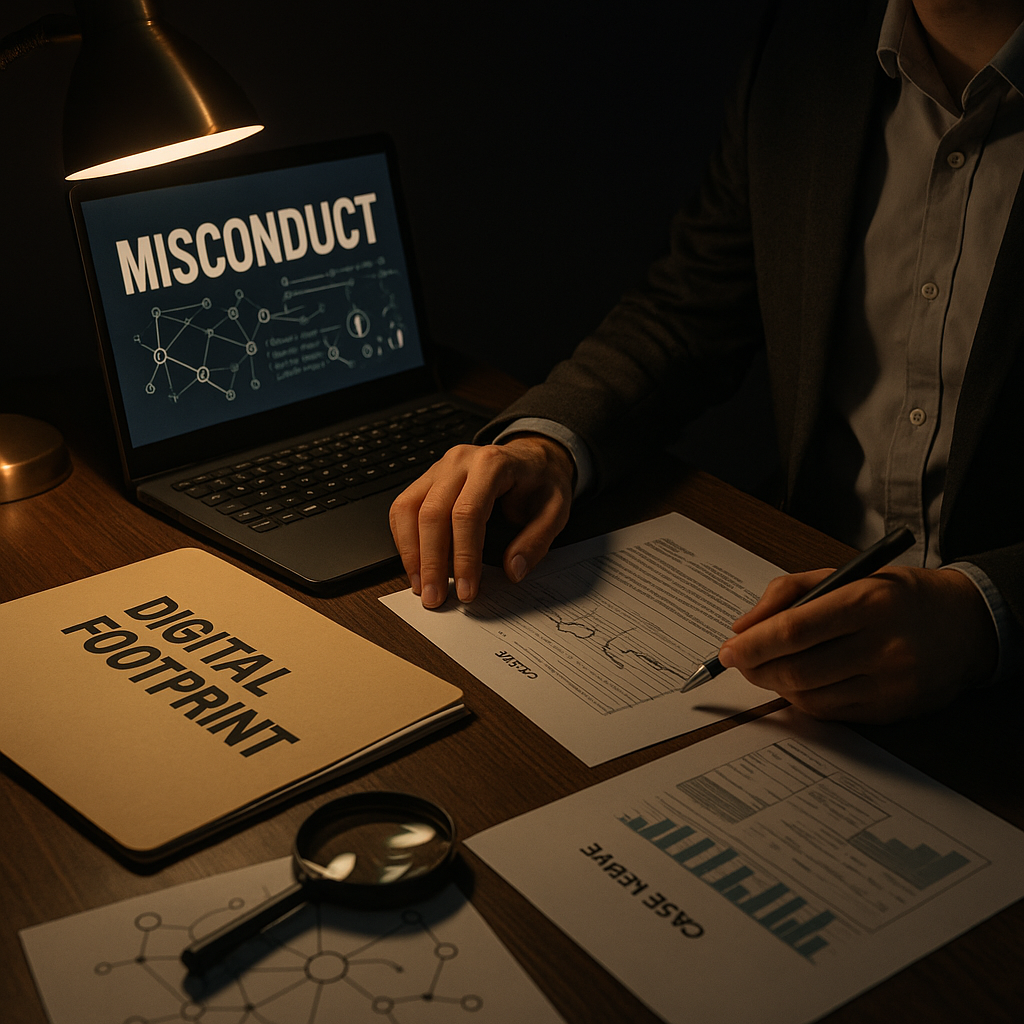
Digital footprints rarely lie. In modern investigations, the most revealing evidence of workplace misconduct sits outside the organization — in online behaviours, secondary accounts, and the patterns employees leave behind across the open internet. This image reflects the quiet, intelligence-driven work behind uncovering those signals.
Misconduct Isn’t Hidden — It’s Online
HR teams are trained to look inward: policies, interviews, documentation, internal systems.
What they are not trained for is the external world — the digital landscape where every employee generates:
signals,
patterns,
behaviours,
connections,
and evidence.
In modern investigations, the truth rarely sits inside the company.
It sits on the internet, in the digital residue people leave when they believe nobody is watching.
Open Source Intelligence — OSINT — is not surveillance.
It is not hacking.
It is not covert access.
It is analyzing publicly available information to understand risk.
And for HR, it has become one of the most powerful, untapped tools for detecting misconduct before it becomes liability.
What HR Misses: Where Misconduct Really Shows Up
Most HR investigations rely on:
interviews
statements
logs
system timestamps
email reviews
policy checks
But internal misconduct rarely reveals itself inside internal systems.
Employees who behave inappropriately at work often exhibit complementary patterns in their digital lives.
Tracepoint’s cases show these three consistencies:
1. Behaviour Offline = Behaviour Online
An employee who:
undermines colleagues
manipulates narratives
forms alliances behind the scenes
spreads misinformation
…will almost always have:
combative social patterns,
suspicious connections,
polarized commentary,
or reputation concerns online.
No platform is needed.
Just their digital footprint.
2. Risky Behaviour is Never Confined to the Workplace
Harassment doesn’t start at work.
It starts in how a person:
messages,
comments,
interacts,
aligns themselves socially.
Discrimination, aggression, boundary violations, and bias leave digital traces.
3. Bad Actors Always Signal What They Believe They’re Hiding
People reveal their values online more honestly than in an interview room.
Digital footprints expose:
hidden affiliations
secondary accounts
online conflicts
personal risk behaviours
concerning ideologies
reputation patterns
financial distress
past misconduct
unstable dynamics
Everything leaves a shadow.
OSINT simply illuminates it.
HR’s Blind Spot: The Digital Field of View
HR is traditionally reactive.
OSINT makes HR proactive.
The digital world offers three layers of insight:
Layer 1 — Open Platforms (Public Data)
Where employees reveal voluntary information:
LinkedIn
Facebook
Instagram
Twitter (X)
Reddit
Quora
public TikTok content
portfolio sites
bios
public comments
Layer 2 — Shallow Web Signals
Where patterns — not posts — expose behaviour:
likes
follows
political affiliations
interest clusters
online conflicts
behavioural trends
social graph
posting times
sentiment indicators
These are often more revealing than explicit content.
Layer 3 — Deep Behavioural OSINT
Where subtlety becomes intelligence:
inconsistencies in identity
evidence of multiple accounts
burner or secondary profiles
content deletions
sudden platform activity changes
contradiction between online narrative and workplace behaviour
This is where Tracepoint operates.
Where Digital Footprints Reveal Internal Misconduct
OSINT uncovers patterns HR traditionally never sees.
Here are the most common misconduct categories that OSINT detects before internal systems ever flag them.
1. Harassment & Boundary Violations
Signs include:
overly familiar messaging patterns
inappropriate comments
age-gap or power dynamic content
concerning interactions with junior individuals
misogynistic or discriminatory posts
“joking” about inappropriate behaviour
The digital tone often matches in-office risk.
2. Hidden Conflicts & Alliance Building
Behaviours like:
targeted criticism
subtweeting colleagues
participating in online hostility
aligning in friend-groups against peers
revealing confidential frustrations
These expose patterns of internal political behaviour.
3. Reputation & Conduct Risk
Employees embroiled in:
public conflict
aggressive online discourse
defamation
extremist ideology
hate content
financial scams
unstable emotional expression
…are significantly more likely to generate workplace incidents.
4. Fraud & Theft Indicators
Digital footprints reveal:
side businesses
financial desperation
gambling issues
unexplained lifestyle changes
unusual secondary income streams
participation in crypto scams
activities that conflict with employment
These correlate strongly with internal fraud cases.
5. False Identity or Misrepresentation
Using OSINT, Tracepoint has uncovered:
fabricated credentials
non-existent certifications
identity inconsistencies
false employment histories
exaggerated achievements
This has major HR, legal, and reputational implications.
Case File: The Associate Who Wasn’t Who He Claimed
Below is a fully fictionalized Tracepoint case file, crafted to illustrate how OSINT transforms HR investigations while protecting anonymity.
🗂️ TRACEPOINT CASE FILE — CF-2032
The Associate Who Wasn’t Who He Claimed
Status: Verified — Digital Risk → Internal Misconduct
Sector: Corporate Services
Summary
An employee was reported to HR for creating conflict, undermining colleagues, and violating boundaries.
The internal review found little — he was courteous, polished, and articulate in every interview.
But the behaviour didn’t match the impact.
Tracepoint was engaged to perform a discreet digital footprint analysis.
Findings:
Across public platforms, the employee displayed a completely different identity:
a secondary account engaging in harassment
participation in hostile online communities
aggressive commentary targeting women
evidence of fabricated credentials
involvement in a crypto-related scam
financially unstable behaviour patterns
The digital identity explained the internal behaviour precisely.
Outcome:
The OSINT review exposed:
falsified credentials
deceitful conduct
boundary risks
reputational exposure
psychological instability indicators
The employee was terminated.
The organization restructured its investigation process to include OSINT for future HR cases.
Why HR Needs OSINT: The Business Case
OSINT is not optional anymore.
It is the missing half of every misconduct investigation. As synthetic content and manipulated communications become more common, some cases also require AI-era misconduct investigations to validate whether digital evidence is authentic.
Here’s why:
1. It reduces legal exposure
Failing to detect digital behaviour patterns increases liability.
2. It protects reputation
Leaders who cause harm offline often cause harm online first.
3. It detects misconduct early
OSINT identifies problems at the behavioural drift stage — long before escalation.
4. It strengthens internal investigations
Digital evidence fills in gaps interviews cannot.
5. It creates a complete profile
HR sees who the employee is at work.
OSINT shows who they are everywhere else.
Together, the two give a complete picture.
The Tracepoint OSINT Method
Tracepoint uses a disciplined, intelligence-grade process:
🔎 Identity Mapping
Cross-referencing identities across platforms.
🔎 Shadow Account Detection
Tracing behaviours linked to secondary or disguised accounts.
🔎 Behavioural Pattern Analysis
Identifying sentiment, conflict, risk, bias, and aggression indicators.
🔎 Digital Reputation Assessment
Evaluating public perception, conflict history, and credibility.
🔎 Risk Classification
Categorizing findings into HR, legal, behavioural, or reputational risk.
The Internet Always Tells the Truth
Internal misconduct hides in conversation.
Digital misconduct hides in plain sight.
The online world is the most honest reflection of an employee’s real behavioural patterns — and the most valuable asset HR has for detecting misconduct early.
As organizations evolve, OSINT is no longer an advanced tool.
It is a necessary one.
Because if leaders ignore digital footprints, they will always be surprised by behaviour that was visible all along.
About Tracepoint Intelligence
Tracepoint Intelligence is a boutique investigations firm specializing in digital investigations, workplace misconduct investigations, open-source intelligence (OSINT), and corporate risk intelligence for organizations, HR leaders, and legal counsel across North America.