Digital Evidence in Workplace Investigations: How to Assess Screenshots, Chat Logs, and AI-Era Misconduct
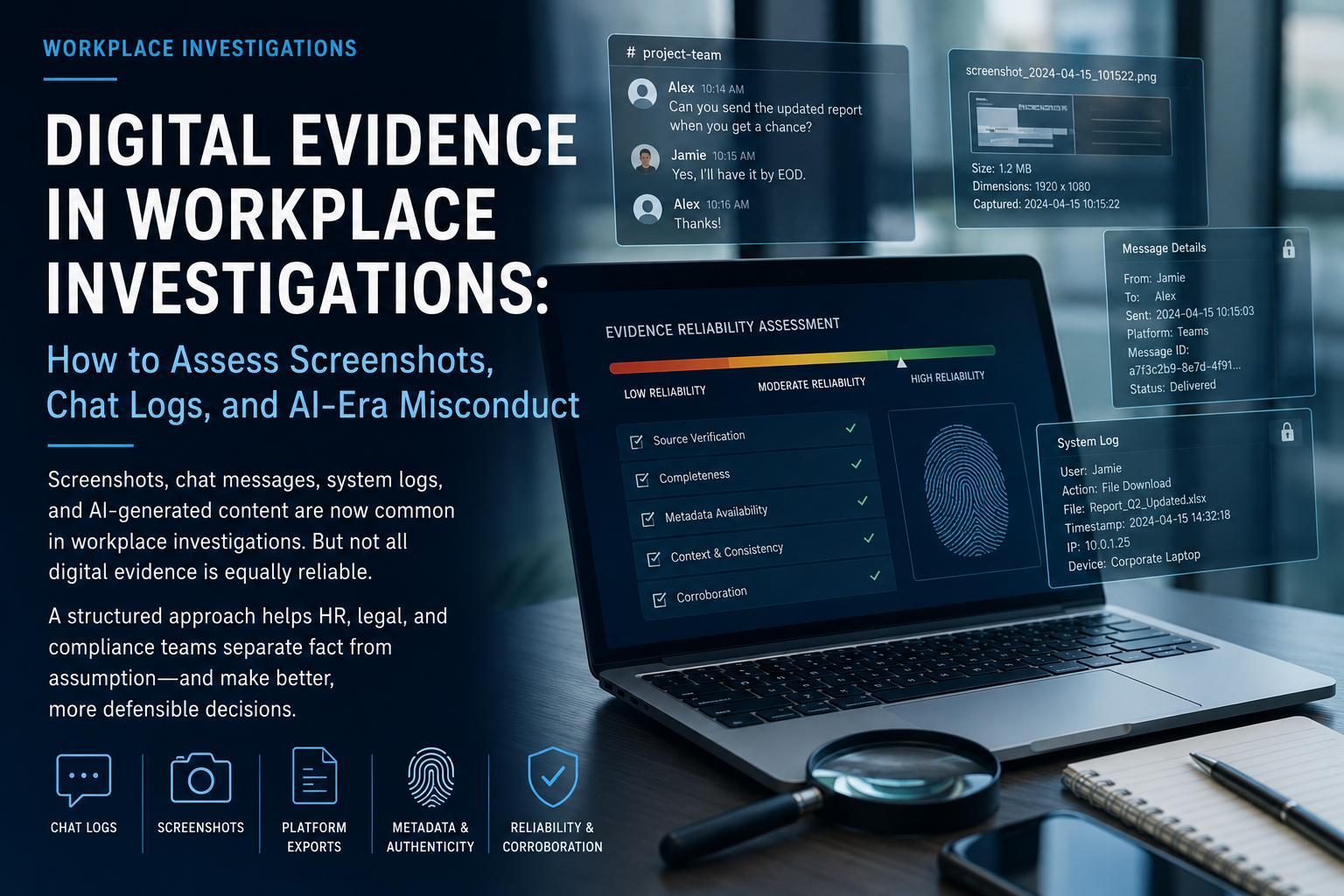
Digital evidence now plays a central role in workplace investigations — but its reliability must be carefully assessed before decisions are made.
Workplace misconduct rarely exists only in conversation anymore.
A harassment complaint may come with screenshots.
A conflict between employees may unfold across Teams, Slack, text messages, or social media.
A productivity concern may involve mouse movers, login activity, badge data, or system access records.
An anonymous report may include copied messages, edited images, or claims about digital behaviour.
And increasingly, workplace allegations may involve AI-generated content, impersonation, fabricated communications, or manipulated evidence.
For HR, legal, compliance, and executive teams, this creates a difficult challenge: digital material can be highly useful, but it can also be incomplete, misleading, altered, or taken out of context.
The question is no longer simply: “Do we have evidence?”
The better question is:
“How reliable is the evidence, and what can we safely conclude from it?”
Digital Evidence Is Not Automatically Reliable
Digital evidence often feels persuasive because it looks concrete.
A screenshot appears to show exactly what someone said.
A timestamp appears to prove when something happened.
A chat export appears to preserve a conversation.
A system log appears objective.
But digital evidence still requires scrutiny.
Screenshots can be cropped, selectively captured, edited, or removed from context. Chat messages can be missing surrounding conversation. Platform activity can show that something happened without explaining why it happened. Logs may require interpretation. Metadata may be unavailable. AI-generated or manipulated content may look convincing at first glance.
This does not mean digital evidence should be dismissed. In many cases, it is essential.
But it does mean organizations need a structured way to assess it before relying on it in an investigation, disciplinary process, workplace review, litigation context, or executive decision.
The Risk of Treating All Digital Evidence the Same
One of the most common investigation mistakes is treating all digital material as though it carries the same evidentiary weight.
It does not.
A screenshot forwarded by a complainant is not the same as a complete platform export.
A copied message pasted into an email is not the same as a verified system record.
A partial chat thread is not the same as a full conversation with metadata.
A claim about digital activity is not the same as independently validated usage data.
When evidence is over-weighted too early, organizations risk making decisions based on incomplete or misleading information. When evidence is under-weighted, organizations may miss important indicators of misconduct, retaliation, fraud, harassment, policy breach, or reputational risk.
The goal is not to be skeptical for the sake of skepticism. The goal is to be precise.
Key Questions to Ask About Digital Evidence
Before relying on digital evidence, HR, legal, and compliance teams should consider several core questions.
1. Where did the evidence come from?
Source matters.
Was the evidence provided by a complainant, respondent, witness, manager, IT team, platform administrator, external counsel, or third-party source? Was it collected directly from a system, exported from a platform, downloaded from a device, or manually captured by an individual?
Evidence collected directly from a source system generally carries more reliability than material that has passed through multiple hands or has no clear origin.
2. Is the evidence complete or partial?
Partial evidence may still be useful, but it should be clearly recognized as partial.
A single screenshot may capture one moment in a longer exchange. A message may appear inappropriate until surrounding context is reviewed. A system record may show access but not intent. A timeline may appear suspicious until shift schedules, role requirements, device sharing, or business context are considered.
Investigators should distinguish between what the evidence shows and what it does not show.
3. Is metadata available?
Metadata can help validate timing, authorship, source, sequence, and integrity.
Depending on the platform or evidence type, relevant metadata may include timestamps, sender and recipient information, message IDs, file properties, export details, audit logs, IP addresses, device identifiers, or administrative records.
The absence of metadata does not automatically make evidence unusable, but it may limit the conclusions that can safely be drawn.
4. Has the evidence been altered, summarized, or reformatted?
Digital evidence often changes form before it reaches an investigator.
A Teams conversation may become a screenshot.
A screenshot may become a PDF.
A PDF may be inserted into a complaint package.
A message may be copied into a Word document.
A social media post may be captured after comments were deleted.
Each transformation can affect reliability, completeness, and interpretation.
5. Can the evidence be corroborated?
Corroboration is often what moves digital evidence from interesting to useful.
A screenshot may be supported by a platform export.
A message may align with witness accounts.
A timestamp may match system activity.
A claim about artificial productivity may align with login patterns, application activity, and device behaviour.
An anonymous report may align with prior complaints, documents, access records, or known workplace events.
The stronger the corroboration, the more defensible the conclusion.
AI-Era Misconduct Raises the Stakes
AI has introduced new evidentiary challenges into workplace investigations.
Organizations may now face allegations involving AI-generated harassment, fabricated screenshots, deepfake images, synthetic audio, impersonation, unauthorized use of AI tools, manipulated documents, or employees using automation to simulate work activity.
This creates two distinct problems.
First, AI can be part of the misconduct itself.
Second, AI can affect the reliability of evidence used to prove or disprove misconduct.
An image, message, report, or document may look authentic but require deeper validation. A workplace allegation may involve content that was created, altered, summarized, or distributed using AI tools. A respondent may claim that evidence was fabricated. A complainant may rely on digital material that appears persuasive but lacks reliable provenance.
In this environment, organizations need more than instinct. They need an evidence assessment process that can withstand scrutiny.
A Practical Reliability Lens
A useful way to approach digital evidence is to place it on a reliability continuum.
At the lower end are materials with unknown origin, limited context, or no metadata. These may be useful as leads, but they should not be over-relied upon without further validation.
In the middle are materials that appear plausible and may be partially supported, but still require corroboration or context.
At the higher end are complete records, official exports, source-system data, and evidence collected with clear provenance and supporting metadata.
This type of framework helps HR, legal, and compliance teams avoid two common errors: dismissing digital evidence too quickly, or accepting it too easily.
What Organizations Should Document
In any workplace investigation involving digital evidence, documentation matters.
At a minimum, organizations should be able to explain:
What evidence was reviewed
Who provided it
How it was collected
Whether metadata was available
Whether the evidence was complete or partial
What steps were taken to validate or corroborate it
What conclusions were drawn
What limitations remained
This documentation does not need to be overly technical in every case. But it should be clear, disciplined, and defensible.
Digital Evidence Should Inform Conclusions — Not Replace Judgment
Digital evidence can be powerful, but it rarely speaks entirely for itself.
A log may show activity. It may not show intent.
A screenshot may show words. It may not show full context.
A platform export may show sequence. It may not explain motive.
An AI-generated artifact may look real. It may not be authentic.
An absence of digital evidence may be meaningful — or it may reflect retention limits, system design, or collection gaps.
The role of an investigator is not simply to gather digital artifacts. It is to assess what those artifacts can and cannot reliably establish.
Why This Matters
Poorly assessed digital evidence can create serious organizational risk.
An employee may be disciplined based on incomplete or misleading material.
A legitimate complaint may be dismissed because the evidence was not properly validated.
A workplace investigation may be challenged because the evidentiary basis was unclear.
A legal team may inherit a file with weak documentation.
An executive team may make a decision without understanding the reliability of the underlying evidence.
In an AI-enabled workplace, these risks are increasing.
Organizations that handle digital evidence well will be better positioned to make fair, defensible, and informed decisions.
Organizations that do not may find themselves relying on material that looks persuasive, but cannot withstand scrutiny.
Final Thought
The future of workplace investigations will not be less digital.
It will involve more messages, more platforms, more screenshots, more metadata, more automation, more AI-generated content, and more disputes about authenticity.
The organizations best prepared for this environment will not be the ones that simply collect more digital material.
They will be the ones that know how to assess it.
Tracepoint Intelligence helps organizations assess digital evidence, AI-era misconduct, workplace complaints, and corporate risk with structure, discretion, and defensibility.
For related support, visit:
Digital Forensics & OSINT Intelligence
/digital-forensics-osint-intelligence
Digital Evidence Analysis / AI-Era Misconduct Investigations
/ai-era-misconduct-investigations
Workplace Investigations & HR Support
/workplace-investigations-hr-support