Employee Activity Monitoring Risks: Digital Evidence Challenges in Workplace Investigations

Digital activity dashboards can suggest consistent engagement — but without validation across systems, they may reflect signals that are incomplete, misleading, or artificially generated.
Digital activity is often treated as evidence.
Status indicators, login duration, and system activity are routinely used to assess productivity and support workplace decisions.
But these signals can be misleading.
Tools that simulate activity — including mouse movers and automated inputs — create a gap between what systems show and what actually occurred.
In a workplace investigation, that gap matters.
Because:
When indicators are mistaken for evidence, decisions become difficult to defend.
This article explores where digital activity signals fail, how simulated activity distorts findings, and how organizations can apply structured investigative thinking to reach defensible conclusions.
When “Activity” Can Be Manufactured
In today’s workplace, digital activity is often treated as a proxy for productivity.
Status indicators.
Mouse movement.
Login duration.
These signals are embedded in dashboards, referenced in performance conversations, and increasingly relied upon in workplace investigations.
But they share a critical limitation:
Mouse movers — both physical devices and software-based tools — simulate activity without actual engagement. While often dismissed as a minor workaround, their presence introduces a much more significant issue:
The integrity of digital evidence.
The Gap Leaders Sense — But Struggle to Prove
Many executives and HR leaders have experienced it:
A sense that something isn’t aligning.
That activity appears consistent — but outcomes don’t.
This is the gap between:
System-generated signals
And actual human behavior
When that gap isn’t examined, assumptions fill it.
And in an investigative context:
Why Surface-Level Signals Fail
Surface-level indicators — such as status icons or login duration — are:
Easily manipulated
Lacking context
Insufficient on their own
Yet they are often treated as conclusions.
In reality:
They are indicators — not evidence.
This distinction is where many workplace investigations begin to break down.
From Indicators to Evidence: Applying Investigative Logic
Proving artificial activity is not about identifying a single moment.
It is about establishing a pattern that holds under scrutiny.
That requires a structured approach grounded in three principles:
1. Correlation Across Independent Sources
No single system should stand alone.
Defensible findings look for alignment across:
System activity
Output or deliverables
Platform usage patterns
The question is not:
“What does this system show?”
But:
“Do multiple systems tell the same story?”
2. Pattern Analysis Over Time
Isolated anomalies prove very little.
However, repeated patterns — particularly those that appear:
Mechanically consistent
Perfectly timed
Misaligned with human behavior
Begin to shift the analysis from suspicion to insight.
3. Contextual Validation
Even strong patterns require context.
Because:
Not all inconsistencies are intentional
Not all anomalies indicate misconduct
Defensible investigations validate:
Role expectations
Workflow realities
Environmental or operational factors
Before conclusions are drawn.
Introducing the Digital Evidence Reliability Scale
At the center of this challenge is a simple truth:
Not all digital evidence carries equal weight.
The Tracepoint Digital Evidence Reliability Scale provides a structured framework to assess:
The strength of different evidence types
Their defensibility in decision-making
In cases involving simulated activity:
Status indicators → Low reliability
Login duration → Low to Moderate
Cross-system correlation → High
Validated behavioral patterns → High
This framework helps organizations move from:
Signals → Insight → Defensible conclusions
Not all digital evidence carries equal weight — and without a structured way to assess it, conclusions can quickly become unreliable. The scale below provides a practical framework for evaluating evidentiary strength in workplace investigations.
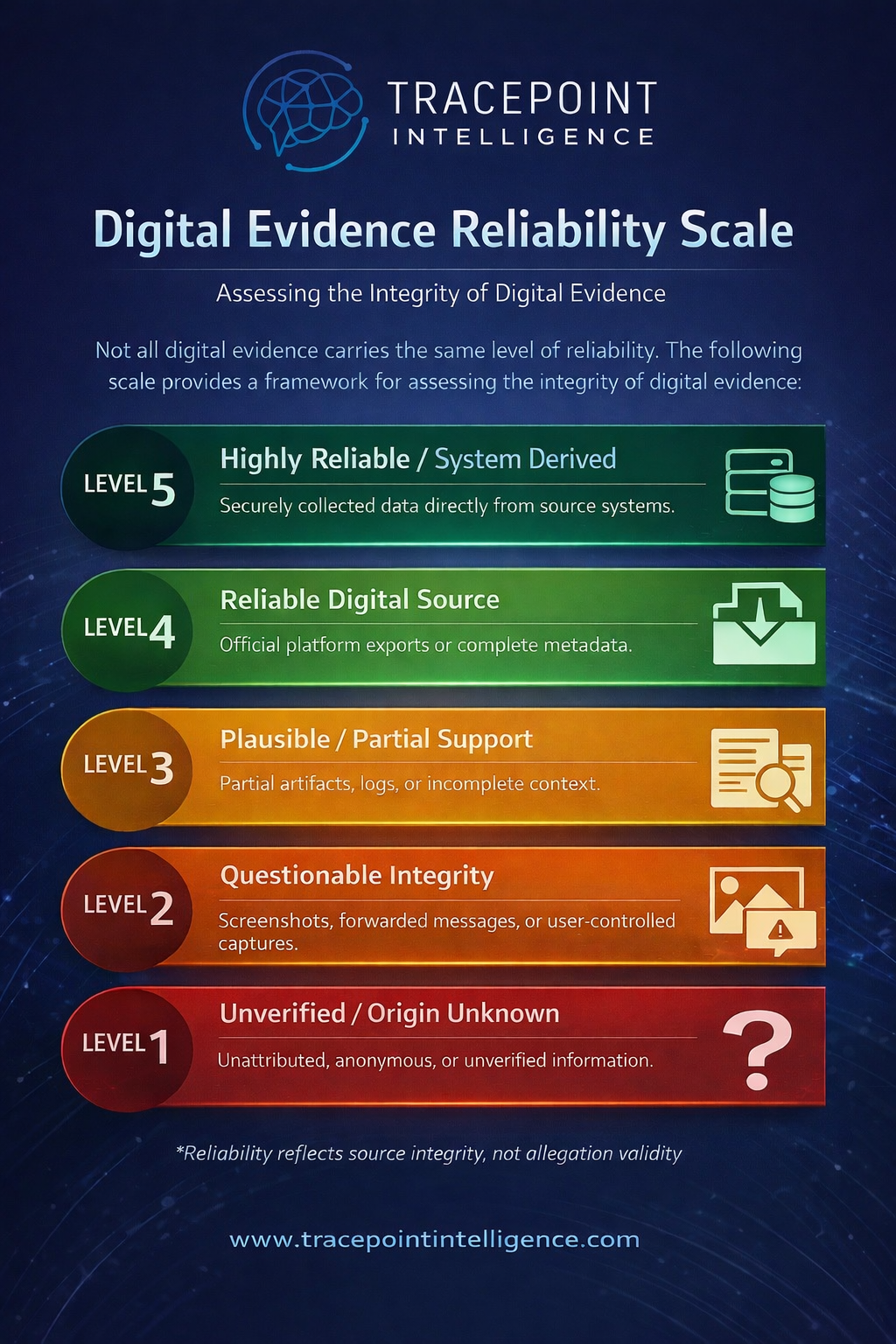
The Tracepoint Intelligence Digital Evidence Reliability Scale categorizes digital evidence from unverified inputs to system-derived data, helping organizations assess reliability and support defensible investigative outcomes.
The Leadership Dimension
This issue extends beyond investigation.
It sits at the intersection of:
Evidence
Decision-making
Organizational trust
Over-reliance on weak signals can:
Undermine credibility
Lead to premature or unsupported decisions
Drive unintended behaviors within teams
Strong leadership does not rely on more data.
It relies on better interpretation of the right data.
The goal is not to monitor activity — but to understand behavior.
What Defensible Organizations Do Differently
Organizations that navigate this well take a deliberate approach:
They treat surface-level signals as directional, not definitive
They validate findings across multiple independent sources
They analyze patterns over time, not isolated snapshots
They document how conclusions were reached
And when necessary, they are willing to pause:
“We don’t have enough evidence yet.”
That restraint is not a weakness.
It is what protects the outcome.
The Real Risk
The risk is not simply that activity can be simulated.
It is that organizations may:
Act on incomplete evidence
Be unable to substantiate decisions
Face legal or reputational scrutiny as a result
Because ultimately:
An investigation is only as strong as the evidence behind it — and the discipline used to interpret it.
Final Thought
As digital work environments evolve, so do the methods used to simulate activity.
The organizations that manage this effectively are not those with the most visibility.
They are the ones with:
Structured investigative thinking
Clear evidence standards
Tracepoint Intelligence provides structured, defensible investigative support across Canada and the United States — specializing in digital evidence, workplace investigations, and complex organizational risk.
If your organization is navigating ambiguous or high-risk digital evidence:
Engage Tracepoint → Begin an Engagement