When Digital Evidence Complicates a Workplace Investigation
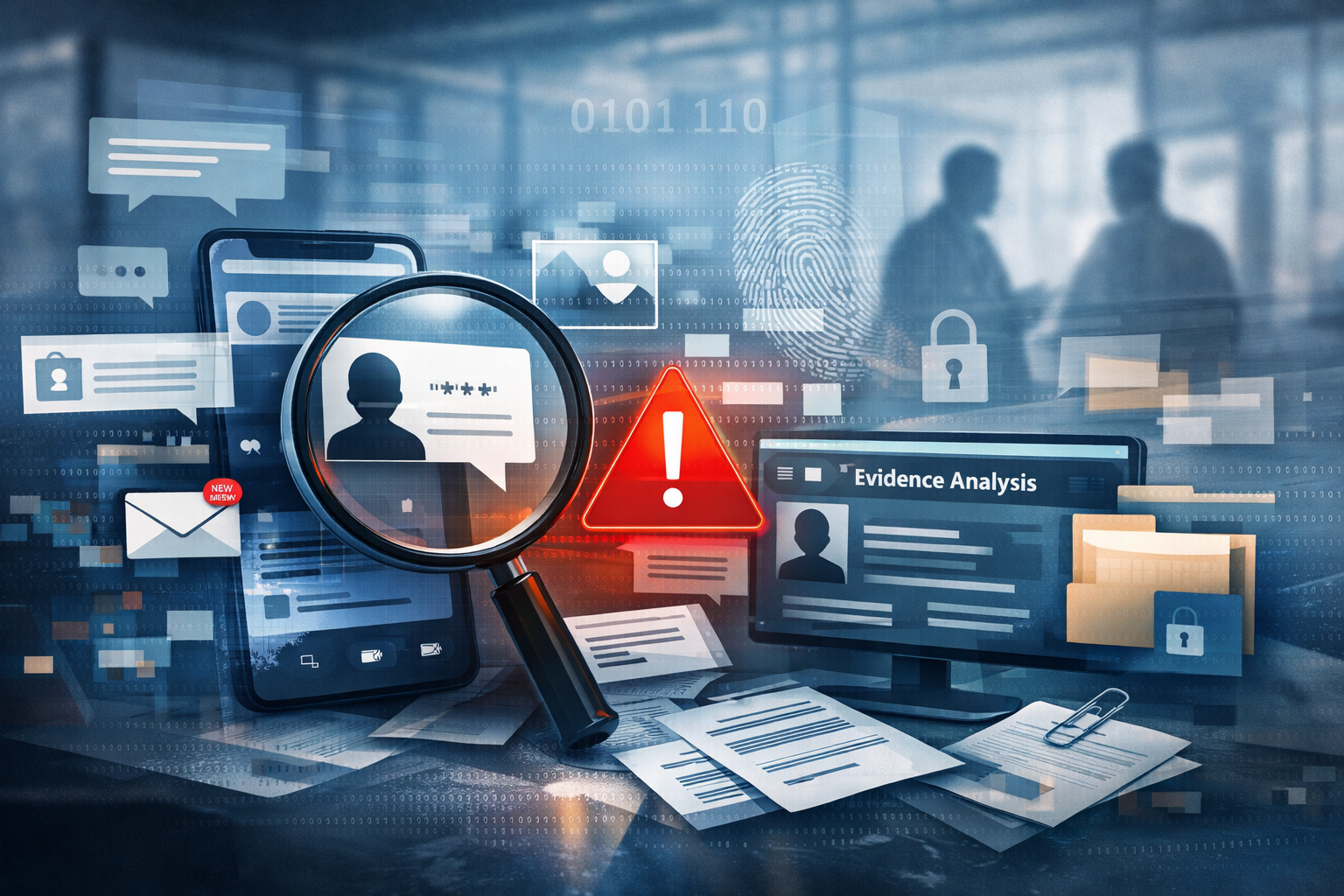
Digital evidence can quietly change the risk profile of a workplace matter long before the facts are fully understood.
Some workplace matters do not announce themselves as high-risk at the beginning.
They arrive in a familiar form: an employee complaint, a few screenshots, a request for HR to review the issue, and immediate pressure to deal with it quickly.
On the surface, the file looks routine.
But in my work, what appears manageable at intake is often far more complex once the underlying facts depend on fragmented digital material, unclear authorship, inconsistent timelines, or online conduct that sits awkwardly between personal behavior and workplace impact.
A recent file pattern illustrates the point.
The Scenario
A senior HR leader receives a complaint from an employee who says they have been receiving hostile anonymous messages over a period of several weeks.
The employee believes a colleague is responsible. They provide screenshots from a private messaging platform, a few saved images from social media, and a forwarded thread from another individual who says similar content had been circulating more broadly.
The accused employee denies involvement. They claim the screenshots are incomplete, selectively presented, and possibly fabricated. A manager, concerned about team disruption, has already spoken informally with several employees. Internal sentiment begins to harden quickly. Some leaders want immediate action.
Identifying the Gaps
At first glance, the file appears to be a familiar workplace issue: a misconduct allegation, conflicting accounts, and a need for prompt review.
But several features make the matter riskier than it first appears.
The first issue is evidence form.
The organization does not have an intact evidentiary record. It has screenshots, forwarded content, paraphrased accounts, and second-hand context. That is not the same thing as having reliable source material.
The second issue is premature narrative formation.
Before the matter has been properly scoped, stakeholders are already moving toward a conclusion. Informal conversations have started. Internal reactions are shaping the file before the quality of the underlying evidence has been assessed.
The third issue is digital ambiguity.
The conduct may have happened outside formal corporate systems, but it may still have workplace implications. The distinction matters. So does the question of whether the material is original, complete, edited, or detached from the surrounding context.
The fourth issue is process exposure.
If the organization makes a significant employment decision based on partial digital evidence and an inconsistently developed record, the defensibility of the process itself may become part of the problem.
At this stage, the organization does not only have a conduct question. It also has an evidence, process, and risk-management question.
What a Defensible Response Looks Like
A defensible response starts by slowing the matter down just enough to understand what the organization actually has.
That includes clarifying the allegation.
What conduct is actually being alleged? Over what period? Through what channels? With what claimed workplace effect?
It means separating evidence from interpretation.
What digital material exists in original form? What has been forwarded or reshared? What has been described by others but not directly obtained? Where are the gaps?
It means identifying immediate preservation needs.
In many matters, preservation questions arise before investigative conclusions do. Waiting too long can narrow the organization’s options later.
It means assessing handling risk.
Has the matter already been discussed too widely? Have internal actors taken steps that may complicate neutrality, confidentiality, or procedural consistency? Is the organization still in a position to structure the file cleanly?
And it means determining the right next step.
Does this require internal handling with tighter structure? Employment counsel oversight? A formal investigation? A more focused external assessment first? The answer depends on more than the allegation alone.
What Can Organizations, legal counsel, and HR leaders Do
Scenarios like this are no longer unusual.
For employment lawyers, senior HR leaders, and corporate decision-makers, the challenge is not simply that workplace issues are becoming more digital. It is that the evidentiary environment around those issues is becoming more fragmented, more portable, and in some cases more vulnerable to distortion.
That changes what reasonable early handling should look like.
It also increases the value of disciplined early assessment before organizations commit themselves to a narrative, a process path, or a significant employment decision.
When a workplace matter involves screenshots, anonymous conduct, online behavior, inconsistent digital records, or possible manipulation, the first risk is not always the allegation itself.
Sometimes the first risk is assuming the file is simpler than it is.
That is where expensive mistakes happen. Not because the organization took the matter seriously, but because it moved from concern to conclusion before the evidence posture and handling strategy were clear.
The most defensible early response is often the one that brings structure first: clarify the issue, assess the evidence environment, identify preservation needs, understand the risk, and then decide what level of response is warranted.
In higher-sensitivity matters, that discipline can make the difference between a manageable file and a much larger problem.
When a workplace matter involves unclear digital evidence, anonymous conduct, online behavior, or facts that do not fit neatly into a routine internal process, early structure matters. Tracepoint supports organizations, counsel, and senior HR leaders in assessing sensitive matters where the right next step is not yet obvious.
About Tracepoint Intelligence
Tracepoint Intelligence is a boutique investigations firm specializing in AI misconduct investigations, workplace misconduct investigations, open-source intelligence (OSINT), and corporate risk intelligence for organizations, HR leaders, and legal counsel across North America.